The demand for high-definition, low-latency live video streaming has expanded rapidly beyond traditional broadcast news into sports production, public safety, enterprise events, and remote REMI workflows. Whether covering a marathon across uneven terrain, reporting from a crowded convention center, or transmitting critical telemetry from a first-responder vehicle, maintaining a stable uplink in unpredictable environments remains a paramount engineering challenge. Standard single-network transmitters often experience packet loss, jitter, or total signal drops when cell towers become congested or coverage weakens.
To overcome these environmental bottlenecks, broadcasters and production teams rely heavily on bonded cellular systems. By dynamically combining multiple distinct network connections into a single robust transmission pipeline, this technology delivers uninterrupted video feeds from virtually any location worldwide.
The Engineering Mechanics of Modern Connection Aggregation
At its core, bonded cellular technology does not simply treat available connections as failover backups; it aggregates them concurrently into one resilient data pipe. An advanced bonded field transmitter breaks an incoming video stream—whether encoded in H.264 or ultra-efficient HEVC (H.265)—into microscopic data packets. These packets are then intelligently distributed across all active connections simultaneously based on real-time network conditions.
The transmission matrix typically leverages a combination of:
- Multiple internal and external 4G LTE and 5G cellular modems from competing telecom carriers.
- Hardwired local area network (LAN) connections or premises Ethernet.
- Local Wi-Fi networks and point-to-point wireless links.
- Mobile satellite terminals, including low-Earth-orbit (LEO) systems.
At the receiving master control facility or cloud-based receiver, sophisticated reassembly algorithms continuously monitor latency, packet arrival times, and packet loss. If one carrier experiences sudden RF interference or bandwidth throttling, the transmitter instantly throttles back packets on that route and reroutes data through higher-performing links. The receiver reconstructs the data stream into pristine, broadcast-compliant SDI, NDI, or IP video before sending it to switchers or master control.
Field Deployment: Backpacks, Vehicles, and Drone Payloads
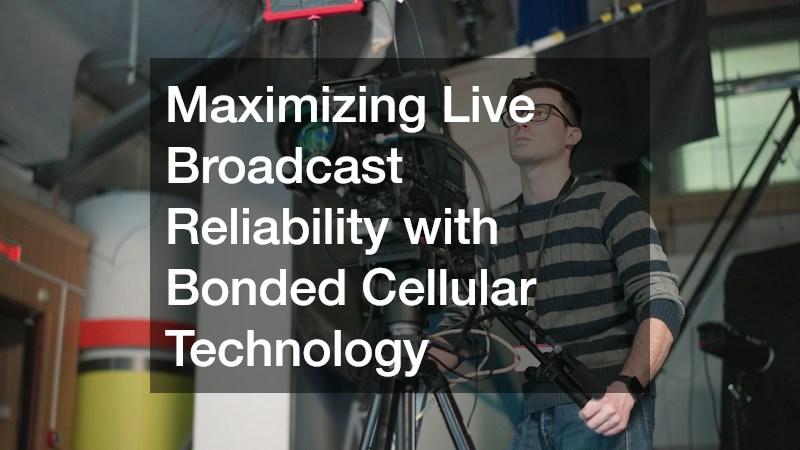
Flexibility in the field dictates the success of modern remote productions. Portable field units, packaged in ergonomic backpacks, allow camera operators to roam freely through dense stadiums, city streets, and rugged outdoor environments without being tethered to OB trucks or satellite uplinks.
Beyond handheld camera operations, bonded cellular transmitters are engineered for integration with vehicular and aerial systems. Roof-mounted active antenna arrays dramatically boost signal gain on production vehicles, news vans, and command centers, providing strong multi-carrier reception even while driving at highway speeds through rural dead zones. Similarly, lightweight transmitters integrated into aerial drones transmit low-latency aerial surveillance and live sporting coverage directly to production suites miles away, eliminating the line-of-sight restrictions of traditional microwave links.
Low-Latency Two-Way Data and Remote Control (REMI)
While high-quality video transport is vital, bidirectional communication is equally essential for modern distributed workflows. The contemporary bonded ecosystem functions as a secure, high-speed bidirectional data bridge between remote crew members and central control rooms:
- Sub-Second Glass-to-Glass Latency: Advanced transmission protocols enable glass-to-glass latency of 0.5 to 1.5 seconds, ensuring fluid question-and-answer interactions between studio anchors and field correspondents.
- Return Video and Teleprompter Feeds: Camera operators in the field can monitor live studio program feeds or read teleprompter graphics sent back over the bonded pipeline.
- Tally and Intercom Integration: Bidirectional audio channels support IFB (Interruptible Foldback) and multi-channel production intercom alongside tally signaling.
- Remote PTZ and Shading Control: Studio engineers can remotely control camera telemetry, adjust iris, balance color shading, and steer PTZ heads thousands of miles away over the cellular data tunnel.
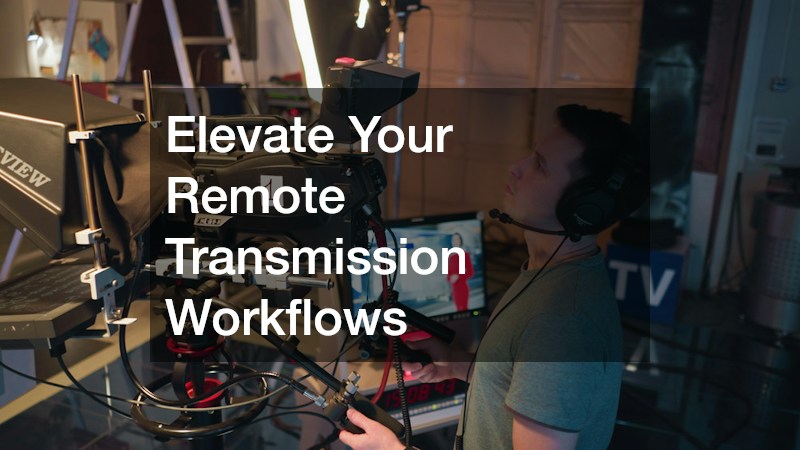
Elevate Your Remote Transmission Workflows
Deploying dependable, ultra-low-latency transmission across complex field environments requires proven hardware and dedicated engineering support. As a trusted leader in video transmission, wireless distribution, and advanced streaming technology, VidOvation delivers state-of-the-art bonded cellular systems, wireless camera links, and custom REMI production solutions tailored to your broadcast requirements.
Ready to eliminate dropped frames and untether your production team? Connect with VidOvation today to schedule a demonstration, explore custom system integrations, and discover the right live transmission architecture for your next broadcast.